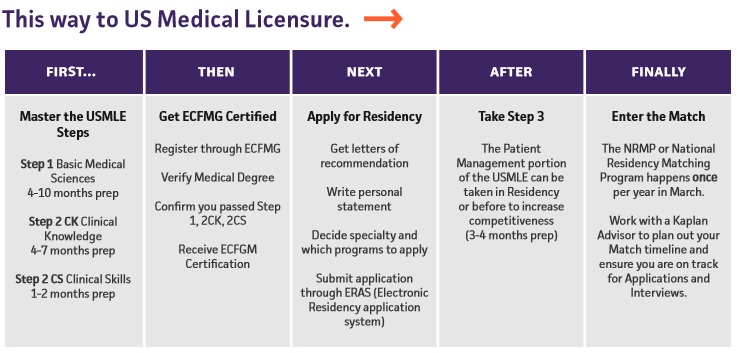
Passing all four tests of the United States Medical Licensing Exam® (USMLE) sequence is required for any doctor to obtain a license to practice medicine in the United States.
- Students and physicians trained outside the US take the same test, and are scored by the same standard as US medical school students.
- USMLE examination is designed to test problem solving, not simple memorization.
USMLE Step 1
USMLE Step 1 is a multiple choice computerized USMLE examination that tests knowledge of subjects learned in the first two years of US Medical School and most of EU Medical Schools.
- Basic Medical Science Exam
- Assesses mastery of basic medical knowledge using clinical vignettes
- 350 questions / 7 hours + 45 minutes break time
- Average Question Length: 60 to 70 words
- We recommend that this USMLE exam be taken first!


USMLE Step 2 CK
USMLE Step 2 CK is a multiple choice computerized USMLE examination that tests clinical subjects learned during the last years of Medical School.
- CK = Clinical Knowledge
- Basic clinical problems assessing preparedness to practice under supervision.
- 370 questions / 8 hours + 45 minute break time
- Average Question Length: 100 to 110 words
- Primary Care focus with emphasis on Internal Medicine (60% of more of the exam)
- A good background in Basic Sciences essential to do well.
- We recommend that this USMLE exam be taken after Step 1.
USMLE Step 2 CS
USMLE Step 2 CS is a “practical” live exam using standardized patients that is meant to test a doctor’s interpersonal, communication and clinical skills. The Step 2 CS USMLE exam tests how doctors take a patient history, perform a physical exam, and write up the appropriate patient note. It also evaluates “bedside manner”, patient interaction, and spoken English skills.
- CS = Clinical Skills
- One day exam with 12 simulated patients (11 scored, 1 experimental)
- Can only be taken in the US (Atlanta, Chicago, Houston, Los Angeles and Philadelphia)
- Exam Basics
- 25 minutes per encounter (15 minutes per patient / 10 minutes for clinical note)
- Step 2 CS Scoring; 3 dimensions
- Integrated Clinical Encounter (ICE)
- Communication/Interpersonal skill (CIS)
- Spoken English proficience (SEP)
- Failing one part of CS, means failing ALL !
- Standardized patients do the scoring using a prepared check-list
- Encounters are videotaped, and a subset scored independently to ensure reliability
- Step 2 CS can be taken whenever students want, but we recommend that it be taken after the completion of Step 1 and 2CK.


USMLE Step 3
USMLE Step 3 combines multiple choice questions and free-form clinical cases on computer, and also tests patient management skills at the level of the 1 st year of Residency.
- Two day exam (16 hour examination)
- 480 multiple-choice questions and 9 clinical case simulations (computerized)
- Assesses capacity for independent medical practice
- Complex issues/patients
USMLE Scoring
Results for the USMLE Step 1, Step 2 CK and Step 3 exams are provided using 3-digit scoring scale.
Exam | 3-digit passing score |
|---|---|
Step 1 | 194 |
Step 2 CK | 209 |
Step 3 | 196 |
Step 2 CS | Pass/Fail |
Many people misunderstand what these scores mean. The 3-digit score does NOT mean the number of questions. (The USMLE does not publish percentile information.)
Understand that 3-digit scale is invented scoring scale intended to obscure information like how many questions the student got correct in USMLE exam. All the student will really know when they see their results is that higher is better and lower is worse.
To have a reasonable chance at getting a residency position, student should try to score about 220 on the 3-digit scale. If they fall short of this mark, they can still get a residency position, but it will be harder.
Note that the USMLE examination is not scored “on a curve”. Students are not scored against each other, but relative to a per-set annual standard. This standard is constant for the year. Both US medical students and IMGs are scored using the same standard.
Pathway to Medical Licensure in the U.S.